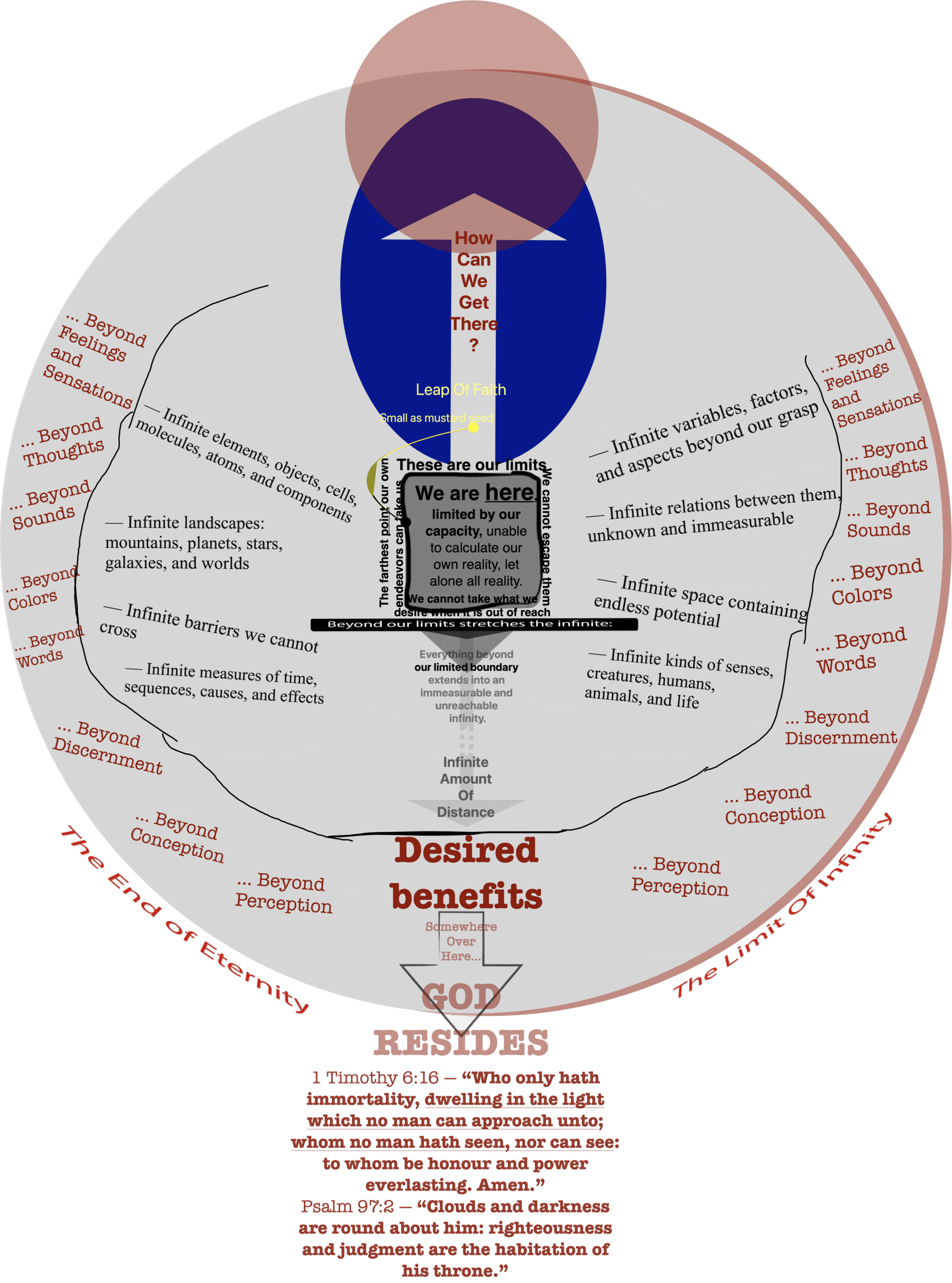
Variables lead to Calculation.
Calculation leads to results.
Results lead to decisions.
Decisions lead to outcome.
An outcome may be beneficial or detrimental.
To be able to control the outcome, we must be able to measure and control the variables that lead to it. We may neither measure all variables, nor control every variable — for we are given limited cognitive resources.
Our calculation, therefore, may never be correct.
The results our calculations yield will never cause us to take the best decisions that carry maximum benefit — our decisions may never guarantee the advantage of the outcome that derives from them.
So, is there any use to be fully awake and aware, when there exists no inherent capability that can perceive and consider all aspects required for taking certain decisions?
Jesus never said “Be awake.”
- Matthew 26:41 — “Watch and pray, that ye enter not into temptation: the spirit indeed is willing, but the flesh is weak.”
- Ephesians 6:18 — “Praying always with all prayer and supplication in the Spirit, and watching thereunto with all perseverance and supplication for all saints;”
- Colossians 4:2 — “Continue in prayer, and watch in the same with thanksgiving.”
But Jesus said, “Be awake, and pray.”
“God will save you from snares, but will not save you from your intentional blindness.” “If you do not open your eyes, you will fall into the pit of your enemy; and if you open your eyes but do not see the snare your enemy has placed before your pit to fall, God will save you from his snare.”
- Psalm 124:7 — “Our soul is escaped as a bird out of the snare of the fowlers: the snare is broken, and we are escaped.”
- Psalm 106:10 — “And he saved them from the hand of him that hated them, and redeemed them from the hand of the enemy.”
- Psalm 18:17 — “He delivered me from my strong enemy, and from them which hated me: for they were too strong for me.”
- Jeremiah 15:21 — “And I will deliver thee out of the hand of the wicked, and I will redeem thee out of the hand of the terrible.”
- Psalm 91:3 — “Surely he shall deliver thee from the snare of the fowler, and from the noisome pestilence.”
- Psalm 124:7 — “The snare is broken, and we are escaped.”
- Psalm 141:9 — “Keep me from the snares which they have laid for me, and the gins of the workers of iniquity.”
- Psalm 144:10 — “Who delivereth David his servant from the hurtful sword.”
- Psalm 22:20 — “Deliver my soul from the sword.”
- Isaiah 54:17 — “No weapon that is formed against thee shall prosper.”
- Psalm 120:2 — “Deliver my soul, O Lord, from lying lips, and from a deceitful tongue.”
- Psalm 31:18 — “Let the lying lips be put to silence.”
- Psalm 109:2 — “For the mouth of the wicked and the mouth of the deceitful are opened against me.”
- Proverbs 2:12 — “To deliver thee from the way of the evil man.”
- Psalm 1:6 — “The way of the ungodly shall perish.”
- Proverbs 4:19 — “The way of the wicked is as darkness.”
- Psalm 23:4 — “I will fear no evil: for thou art with me.”
- Psalm 91:5 — “Thou shalt not be afraid for the terror by night.”
- Psalm 34:4 — “He delivered me from all my fears.”
- Psalm 72:4 — “He shall break in pieces the oppressor.”
- Psalm 119:134 — “Deliver me from the oppression of man.”
- Isaiah 54:14 — “Thou shalt be far from oppression.”
- Psalm 18:16 — “He drew me out of many waters.”
- Psalm 124:4 — “Then the waters had overwhelmed us.”
- Psalm 31:4 — “Pull me out of the net that they have laid privily for me.”
- Psalm 21:11 — “For they intended evil against thee.”
- Psalm 140:2 — “Which imagine mischiefs in their heart.”
- Psalm 10:2 — “Let them be taken in the devices that they have imagined.”
- Psalm 7:1 — “Save me from all them that persecute me.”
- Psalm 142:6 — “Deliver me from my persecutors; for they are stronger than I.”
- Jeremiah 20:11 — “My persecutors shall stumble, and they shall not prevail.”
- Psalm 40:2 — “He brought me up also out of an horrible pit.”
- Psalm 30:3 — “Thou hast brought up my soul from the grave.”
- Psalm 7:15 — “He made a pit, and digged it, and is fallen into the ditch which he made.”
- Psalm 124:3 — “Then they had swallowed us up quick, when their wrath was kindled against us.”
- Psalm 27:2 — “When the wicked… came upon me… they stumbled and fell.”
- Lamentations 3:60 — “Thou hast seen all their vengeance and all their imaginations against me.”
- Psalm 25:2 — “Let not mine enemies triumph over me.”
- Psalm 35:4 — “Let them be confounded and put to shame that seek after my soul.”
- Psalm 109:29 — “Let mine adversaries be clothed with shame.”
- Psalm 50:15 — “And call upon me in the day of trouble: I will deliver thee.”
- Psalm 27:5 — “In the time of trouble he shall hide me.”
- Ephesians 6:13 — “That ye may be able to withstand in the evil day.”
- Psalm 52:4 — “Thou lovest all devouring words, O thou deceitful tongue.”
- Psalm 64:3 — “Who whet their tongue like a sword.”
- Psalm 101:7 — “He that worketh deceit shall not dwell within my house.”
Awakeness is not a result but a process.
Awakeness does not guarantee success — only the Lord’s promise does.
Awakeness does not guarantee outcomes; it guarantees maximum return on full investment.
Awakeness is maximum investment.
The return awakeness yields is always directly proportional to the depth of the investment. And the depth is limited to one’s capacity.
If one can offer only a small maximum, then the return will be small — regardless of the fact that he invested everything he had. If all he has is little, it is nonsense to expect a great return.
And if this small return does not satisfy him, he needs grace from above; for there is nothing else he can do, but to hope for the merciful provision of the Richest One, Who has it all.
This return, when one invests his all, is simply the limit of what a person is capable to produce by himself — this is honest work that earns humble living, yielding results according to the limit of the full potential we are given from God.
Whatever method one may use to increase this return will fall even shorter than that limit — the pursuit of greatness becoming the cause of its own smallness. All attempts that seek to work above their assigned limits end up smaller than the limit they sought to exceed — they fall beneath the very limit it tries to surpass. No technique can surpass one’s true capacity; if it did, it would be cheating. To buy an expensive Mercedes for $200 is a theft — unless the difference is granted by the grace of the seller. A diligent work is to work according to your strength — less is cheating, more is cheating.
To despise and disregard this small value is to reject humility.
God values the ants and worms of this world; our worth is far greater than theirs — how much, then, God values us, despite our little value?
To deny our little value is to deny all value God has assigned to His creation —
and in doing so, to deny God’s authority itself; which is to deny the value of God himself.
Denial of our little value is denial of humility — which is pride — thus, it is inappropriately, by trickery, taking the place of the Assigner of value. In nature, this is a deceitful excuse that protects the desire never to invest oneself, disguised as humility. It claims, “My actions are of little value, therefore, I don’t do them.” Or “I will stop trying until I find actions that are of high value.” But what is of higher value — little or nothing?
Proud people always choose nothing in their ambition to gain everything;
humble people choose little.
Therefore the proud become idle, for they do not value honest work — and so they refuse it. They seek to increase their value and their returns by untruthful means.
But to do less and receive more is theft;
and to do more than you truly can and receive more is also theft —
for theft is everything that crosses the boundary of ownership uninvited; it is trespassing.
To take what does not belong to you is theft — unless it is given to you by grace.
And to seek what does not belong to you is coveting — unless you seek it as grace by faith.
Awakeness is a continual act of conscious measuring — simply that. It does not come with numbers attached to it. It is a process. A process in itself is never at fault for failing to reach a desired goal; the fault is searched is whether we invested it fully, and whether the goal was realistic. The act of walking is not blamed if it takes ten steps instead of a desired hundred.
If the process gave its maximum, then the shame falls on the expectation, not on the process itself.
- A process is evaluated by whether it gives its maximum, not by whether it met expectations.
- When full effort is given but the result is small, the expectation — not the effort — was flawed.
- A process is just the path — the only passage an activity can be carried through — the route by which the activity exists.
- How much we learn within that activity depends entirely on how much we invest: after any true investment, limits are revealed, lessons are learned, and those very limits are thereby extended.
Awakeness is a process that never ceases to operate — an infinite sum of subsequent acts of proactive observing and aware contemplating. This faculty and it’s measuring precision grows and improves by use and weakens and degrades by neglect.
If one desires good results, he must use it continually, because its use increases the fruit it yields.
What are good results? Any result that is appropriate to the full capability of the awakened one.
To seek a mechanism that performs perfectly on first use is to remain forever in the same place — a place that yields not small results, but no results at all.
Awareness is unaware of the final result. It is a continual act of conscious measuring — solely focused on the variables that shape the results. God is the Omniscient — able to see everything in one glimpse and measure the universe in the palm of His hand — and only he can calculate all the variables under the sun and get a precise result. All variables are infinite in number, and only the Eternal One can calculate infinite variables and produce a tangible number.
Honest work is to remain awake to who you are and to what God has entrusted to you, and to invest in exact measure: a son of God will not be allowed to fail if he gives his all he has, and refuses both to work beneath his limits — however great they may be — and to pretend he can work beyond them — however small they may seem — rejecting both laziness below his limits and pride beyond them.
An honest worker acknowledges his true nature, and his true identity, and his true position:
- that he is a created being with limits, whose success is sustained by the loving grace of the Unlimited Father;
- that he is fallen by disobedience and through disregarding of these limits;
- that he is redeemed by the same grace of the Father.
An honest worker recognizes that true success and great results depend on the mercy of his Father, and not on the measure of his created capacity.
Leave a Reply