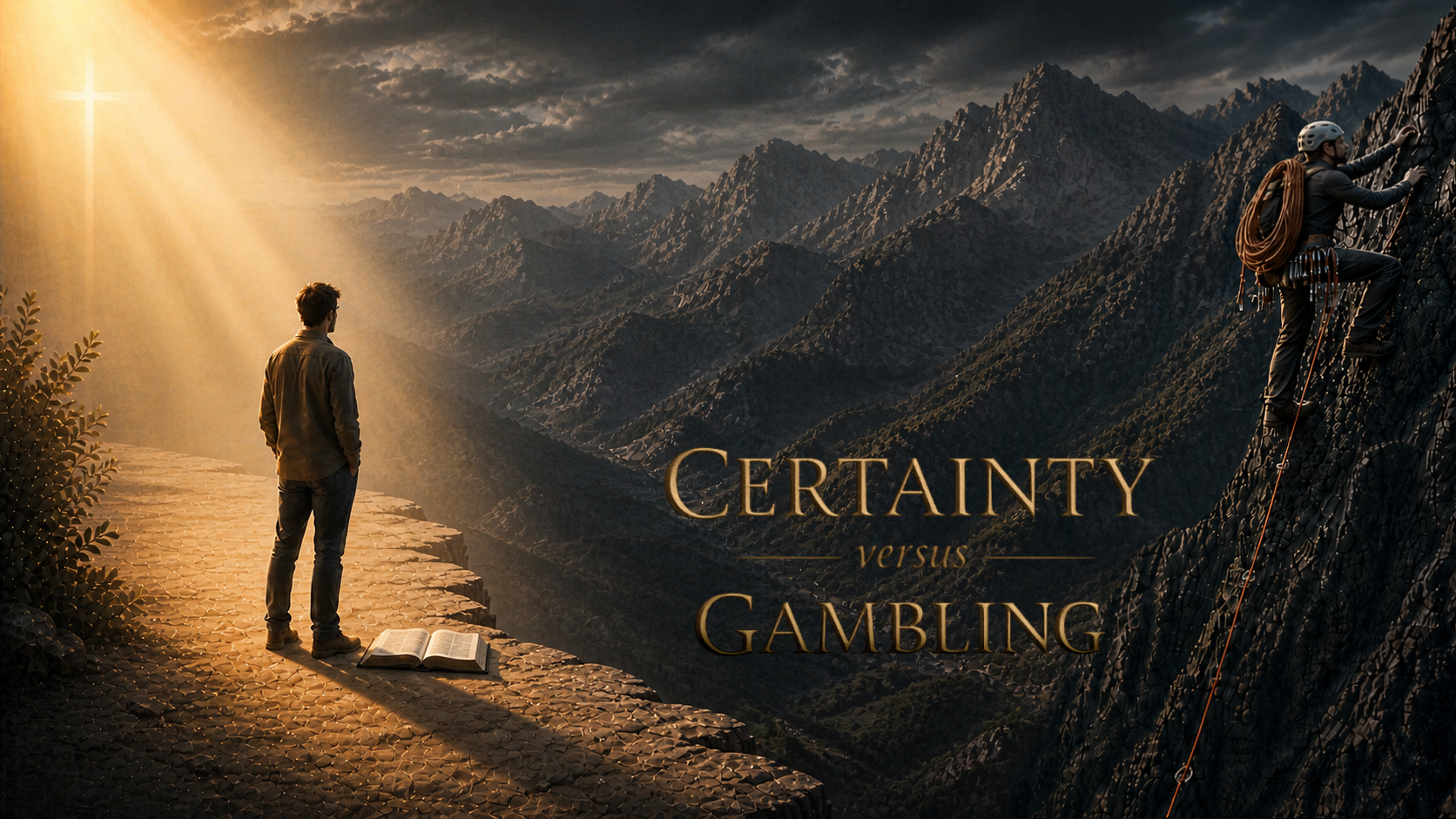
Faith as Certainty
The certainty we receive through faith is not human assumption, but certainty that rests upon God’s Word.
It begins where man stops relying on his own opinion and begins to stand upon God’s Word as certainty.
The certainty that comes from faith is not born from human desire. It is not born from man’s need to be right. It is not born from the fear of being unprotected.
It is born from the trustworthiness of God’s Word.
From the One who speaks truth.
From the One who cannot lie.
From the One whose Word stands when human thought falls apart.
Therefore, faith is not empty belief or opinion. In faith, there is not one drop of assumption. Faith is knowledge — the knowledge of God. Faith is certainty. It is trust.
Faith is trust in God. It means that we know Him — that we know His character, that we know His promises are absolute certainty, and that we can lean upon them with absolute peace and rest in them.
This is what God says of Himself:
- 1 Corinthians 14:33 — “For God is not the author of confusion, but of peace, as in all churches of the saints.”
God does not create temporary certainty, relative truth, or apparent stability. He creates reality — and the reality He creates is certain. He speaks truth — and the truth He speaks is not ambiguous. God does not create disorder, general uncertainty, or unclearn — He is not the author of traps. With God, truth does not disappear tomorrow as if it were only for today — but is firm, clear, and lasting. What God has spoken remains through eternity — unchanged — as reality that is certain and upon which we can fully rely — without the slightest stain of uncertainty.
- Isaiah 5:20 — “Woe unto them that call evil good, and good evil; that put darkness for light, and light for darkness; that put bitter for sweet, and sweet for bitter!”
The Reality God Has Spoken
By His Word God created the world — He spoke, and it was. The reality around us is certain because God created it. Who can deny it? Who can doubt that the sun shines while looking straight at it? Who can doubt the winter cold while standing outside unclothed?
Who can tear off his own finger and be uncertain that the consequences and the loss are real?
Who does not fear a lion that roams for prey? Do you have even one drop of courage to approach it unprepared?
And does not the man who questions reality and places the world around him under doubt live every day with certainties that he does not question, and that he does not dare dissolve into mere relativity or treat as uncertain? He may deny certainty with words, but he cannot escape it with his life.
Does the man who argues against certainty dare to live as if there is no certainty?
He may make reality relative in thought, but he cannot make it relative in life. He may speak as if everything is uncertain, but he cannot live as if nothing is certain.
Does he not know his own name? Does he not recognize his own breath, his heartbeat, and his need for oxygen?
Are even the philosophers who interpret reality not subject to the law of the heartbeat and to the unavoidable need to breathe oxygen into their lungs? Can they change the laws of nature with their philosophies?
We all live in the certainty that God has spoken into reality, and which certainly stretches around us. His Word is certainty. And if we receive it with faith in which there is not one drop of doubting, we also will stand certain through that Word — and that certainty will give us absolute peace.
Then we will no longer flee when no one pursues us. We will not fear when danger is imagined or calculated by our own personal mathematics. Then we will see the world and life as God created them — and we will be certain in that sight.
And there will be no living force that can steal it from us, cloud it, or distort it. We will clearly see what is truth and reality before God.
And the certainty that is from God will become our certainty — because we have received it without doubt, resistance, calculation, or invention.
From Faith to Assumption — When Man Creates His Own Certainty
If faith is certainty in God and in His Word, then the opposite of faith is not only unbelief. The opposite is man creating his own certainty — his own version of reality — where God has not spoken.
There assumption begins.
And when assumption seeks to rule over the future, it becomes spiritual gambling.
And this is presumption — because it takes the role that belongs to God alone.
The Boundary of Truth
Truth, for us humans, can be received only thorough two safe channels:
- what God has revealed through His Word,
- and what truly stands before our eyes and is available for examination — that which does not pass beyond the present, and does not pass beyond the space within our reach.
God’s revelation is certain because God cannot lie. Present reality can be examined because it stands before us, without hiding itself. But the future which God has not revealed to us does not stand before us. We do not see it. We do not possess it. We do not control it. We cannot force it to become certain by imagining it, fearing it, desiring it, or calculating it.
Truth, in our sight — or perception — ends at the present moment, unless God has spoken beyond it, revealing what has not yet happened. This means that we have testimony only up to today. We were present yesterday; we are present today; but we are not present tomorrow. Therefore, for us humans, the boundary of truth or certainty does not extend even fifteen minutes beyond this moment, nor beyond the space where our access is limited or completely unavailable.
What stands before us may be examined. What God has revealed may be believed. But what stands beyond present sight — extending into the future — and beyond God’s revealed Word does not belong to certainty.
The Movement of Assumption
Assumption has a different movement than certainty. It begins with what has already been seen. It begins with past experience, past evidence, past pain, past success, past danger, or past patterns. But it does not stop at the present, where sight ends. It continues into the future, where sight is no longer present, and there it tries to seal its conclusion as truth.
So truth ends where God’s revelation and present evidence end. But assumption travels beyond that boundary. It begins with the past, passes through the present, and tries to possess the future.
This does not mean that the future is uncertain to God. For God, the future is open before His eyes. He knows the end from the beginning. To Him, tomorrow is not darkness. Nothing is hidden from Him. God sees the future as we see the past and the present.
But for us, the future is hidden unless God reveals it.
Therefore, when man speaks about the future as God has revealed it, this is faith — certainty in God’s Word. But when man speaks about the unrevealed future as if he knows it, this is not certainty, but assumption.
Man often assumes that his sight is not limited by design — that God has given him some kind of dominion over the future. But such dominion is given only when it rests on God’s Word. When God speaks about the future and we believe Him, this is faith. Faith in His Word is the only true way by which man may stand with certainty concerning the future. It does not rely on man’s sight, fear, desire, or calculation, but on the certainty of God and His Word.
When we assume that a word belongs to God when He has not spoken it, this is no longer faith. It is presumption. And presumption is disobedience, which God hates. God never asks us to guess what His Word says.
Therefore, when man speaks about the unrevealed future as if he knows it, he has crossed the boundary from truth into assumption. He has left what is given and entered what is not given. He has taken a possibility and crowned it as certainty.
Assumption begins the moment God’s revelation and present evidence end.
Assumption takes for itself an unauthorized freedom. It begins with what has already been seen, but it does not stop where sight stops. It stretches the past into what has not yet happened. It interprets the future according to what it has already seen, treating a partial pattern as if it were a guaranteed outcome. It looks at yesterday and today, then claims ownership over tomorrow. It assumes it has both skill and power to calculate a pattern of events that will surely come to pass. It says, “Because this has happened, this must happen.” But the future has not yet testified that this will happen.
This is not knowledge. It is projection. Assumption treats what it sees as everything there is, and then speaks as if nothing beyond its sight can overrule its conclusion.
The error is not that man observes patterns. The sin is not in seeing danger or preparing wisely. The sin is not in observing what is happening or considering possible consequences. Wisdom may prepare. Prudence and discernment may count the cost. Faithfulness may act responsibly today and avoid future loss.
When Assumption Becomes Gambling
The sin begins when man takes the unrevealed future and treats it as if it were revealed — when he turns possibility into certainty without God’s Word.
Then assumption becomes false prophecy: fear, desire, or human reasoning begins to speak as if it were the voice of God.
It no longer says, “This may happen.”
It says, “This will happen.”
It no longer says, “This danger should be considered.”
It says, “This danger owns the future.”
It no longer says, “I should act faithfully today.”
It says, “I must secure tomorrow by my own calculation.”
That is where certainty becomes gambling. And gambling is sin, because it steps outside God’s light and enters the darkness where the devil works and sin dwells. The devil is the father of lies and the fountain of moral evil; and gambling is one of the many streams through which his lies flow and his evil is practiced.
Gambling is not only the throwing of money into chance. Gambling is the moral act of stepping outside the light God has given, entering the darkness of the unrevealed, and risking obedience, peace, faith, or duty — in an attempt to secure an outcome God has not promised.
A man may find gold there. But he may also find death. He has no divine guarantee of the outcome, because God did not send him there.
The issue is not whether the result succeeds. The issue is whether the step was taken in light or in darkness.
This is the attempt to avoid future loss by sacrificing the light, duty, peace, and benefits God has given today. In short, it avoids future loss by sacrificing the benefits of today.
If we live by truth, we remain within what God has revealed and what God has placed before us. We do not deny reality. We do not ignore danger. We do not refuse responsibility. But we also do not let fear, desire, probability, past experience, or human calculation become our god.
We may analyze what is present.
We may obey what God has commanded.
We may prepare according to wisdom.
We may trust what God has promised.
But we may not declare the unrevealed future as certain.
The present is our field of faithfulness.
God’s word is our boundary of certainty.
The future is God’s possession.
When a person tries to live in the future, it is usually because he is not resting in the present. He is not satisfied with what God has given him to know, obey, and trust today. He reaches beyond the revealed boundary because revealed truth feels insufficient. He wants more certainty than God has offered.
But this desire for more certainty is not faith. It is greed dressed as caution. It is fear dressed as wisdom. It is unbelief dressed as responsibility.
Such a person does not simply want guidance. He wants control.
He does not simply want to obey God today. He wants to master tomorrow before it comes. He does not rest in God’s revealed will. His eye searches beyond it, looking for a hidden advantage, a safer path, a stronger guarantee, a certainty God has not given.
And when the human eye searches for more than truth, it does not become wiser. It becomes insatiable.
This is the doorway into spiritual gambling.
God’s Ground and the Darkness of the Unrevealed
The devil does not need to make a man reject truth openly. It is enough to make him feel that truth is not enough. It is enough to draw him beyond what God has revealed, into a place where fear can invent, desire can distort, and imagination can command.
There, the battle is no longer fought on God’s ground.
On God’s ground, we have truth.
On God’s ground, we have duty.
On God’s ground, we have promise.
On God’s ground, we have grace for today — gifts appointed for the harvest of today.
But outside the light God gives, man has no certainty. There he has only calculation. Only probability. There he has only fear, desire, and speculation pretending to be sight.
This ground belongs to darkness, and Satan works there. Men may freely choose to enter it, even though God has warned them not to walk in darkness, lest they die. And when they nevertheless choose darkness, God does not force them back into the light, because God desires willing service, not forced obedience.
The Unbreakable Rule
Therefore, the rule is unbreakable:
What God has revealed is truth.
What God has commanded is duty.
What God has promised is certain.
What is presently before us may be examined.
What God has not revealed must not be treated as knowledge.
What fear imagines must not be obeyed as prophecy.
What desire predicts must not be trusted as guidance.
What calculation suggests must not be enthroned as certainty.
When calculation becomes authority, it becomes sin.
The Faithful Man and the Future
The faithful man does not gamble with the future.
He receives the light God gives.
He walks in the duty God reveals.
He prepares only as far as wisdom and obedience allow.
He refuses to worship imagined outcomes.
He refuses to call assumption truth.
He refuses to leave God’s ground in order to seek a sense of safety beyond the safety God has provided.
He does not need to own tomorrow, because God already does.
And because God owns tomorrow, man is free to be faithful today.
Leave a Reply